
Tai'an Hi-tech Development Zone, Shandong, China
Call Us
+86 155-8858-6611


Views: 112 Author: Site Editor Publish Time: 2026-03-21 Origin: Site


In the 2026 industrial landscape, vertical mobility is no longer a simple utility; it is the backbone of high-density logistics and modular manufacturing. The Industrial Scissor Lift has emerged as the most critical category within the global Aerial Work Platform (AWP) industry, currently commanding a 43.5% market share of all active powered access units worldwide.
The shift from traditional, static scaffolding to compliant powered access is not merely a trend—it is a response to the "Efficiency First" mandate of modern industry. Statistics from the International Powered Access Federation (IPAF) indicate that projects utilizing scissor lifts instead of traditional ladders or scaffolding see a 312% increase in man-hour productivity. By allowing a single operator to transport both themselves and their heavy tooling (up to 700kg) to height in under 60 seconds, these machines have become indispensable. Brands like TERLION have catalyzed this shift by focusing on "Ready-to-Work" uptime, ensuring that the machine is a seamless extension of the technician’s workflow.
The core of a scissor lift’s superiority lies in its pantograph mechanism, which converts horizontal hydraulic force into perfectly linear vertical motion. Unlike boom lifts, which rely on a cantilevered arm that creates massive rotational torque on the chassis, the scissor lift keeps its center of gravity (CoG) within its mechanical footprint.
In an industrial-grade lift, the distribution of stress across the scissor stack is calculated to a microscopic degree. When the platform is fully extended to, for example, 14 meters, the lateral forces (wind or manual push) create a bending moment on the pins.
l The Material Science: While light-duty lifts use standard A3 carbon steel, professional-grade manufacturers like TERLION employ Q345B Manganese Steel. This provides a yield strength of 345 MPa, ensuring that the "platform sway" is minimized to less than 0.5% of the total height.
l Rigidity and Deflection: High-tensile steel allows for thinner, lighter arm profiles without sacrificing the Safe Working Load (SWL). This reduces the overall machine weight, which is critical for floor-loading restrictions in multi-story warehouses.
A common mistake in procurement is selecting equipment based solely on "Maximum Reach." To ensure long-term ROI, buyers must evaluate the Machine Mass-to-Capacity Ratio and duty cycle ratings.
l Light-Duty: Designed for occasional use (1-2 cycles per day). Often lacks active pothole protection.
l Rental-Grade: Built for durability and ease of transport. Must withstand high-frequency use by different operators.
l TERLION Industrial-Grade: Specifically engineered for 3-shift continuous operation. This class features oversized hydraulic reservoirs for cooling and high-duty cycle AC drive motors that do not overheat during constant repositioning.
Parameter | Standard Specification | Industrial High-Performance |
Lifting Capacity (SWL) | 230 kg | 450 kg - 750 kg |
Lifting Speed (Max) | 0.18 m/s | 0.25 m/s (Variable Speed) |
Gradeability | 25% | 30% - 35% |
Platform Extension | 0.9 m | 1.2 m - 1.5 m |
Incline Alarm (Tilt) | 1.5° / 3.0° | Precision Multi-Axis Sensing |
The power system is the single largest factor affecting the Total Cost of Ownership (TCO). By 2026, the industry has largely decoupled from traditional lead-acid technology in favor of Lithium-ion (LiFePO4).
While the initial purchase price of a Lithium-powered scissor lift is approximately 15-20% higher, the long-term data is undeniable:
l Energy Efficiency: Lithium systems operate at 95% charge/discharge efficiency, whereas lead-acid loses nearly 20% of its energy as heat during the charging process.
l Cycle Life Data: A lead-acid battery provides 500-700 cycles (to 50% depth of discharge). A TERLION optimized Lithium pack provides 3,500+ cycles (to 80% discharge).
l Zero Maintenance: The elimination of "battery watering" and acid cleaning saves an average of 48 labor hours per machine, per year.
l Opportunity Charging: Lithium allows operators to plug the machine in during a 30-minute lunch break, adding enough capacity for another 2-3 hours of work without damaging the battery’s "memory."
As "Zero Emission Zones" (ZEZ) expand across North America and Europe, the electric drive system has become the global standard. Modern industrial scissor lifts now feature Brushless AC Motors, which offer 25% more torque than older DC brushed motors, allowing the machine to navigate steep loading ramps with a full 500kg load without stalling.
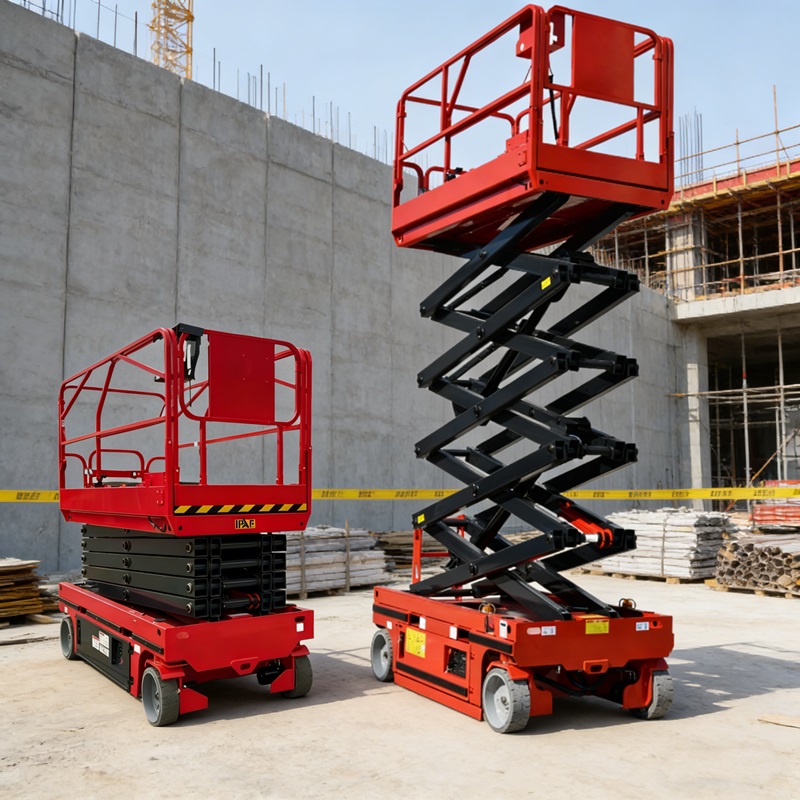
In the aerial work platform industry, safety is not an "add-on" feature; it is the fundamental engineering constraint. As of 2026, global markets are governed by the harmonized standards of ANSI A92 (United States) and EN 280 (Europe). Failure to meet these standards results in a 100% rejection rate by Tier-1 construction sites and high-value industrial facilities.
Industrial-grade scissor lifts, such as those refined by TERLION, integrate a multi-layered defense system to mitigate the three primary risks: tip-overs, falls, and structural collapse.
l Tilt Protection & Interlocks: Sensors calibrated to ±0.1° accuracy continuously monitor the chassis. If the incline exceeds 1.5° (side-on) or 3° (longitudinal) while elevated, the system automatically disables "Drive" and "Lift" functions, allowing only "Lowering" to return the operator to a safe state.
l The Pothole Protection System (PPS): This is a mechanical or hydraulic fail-safe. When the platform rises above 2 meters, steel plates deploy to reduce ground clearance to approximately 20mm. If a wheel enters a floor opening or a pothole, the chassis rests on these plates, preventing a catastrophic tip-over.
l Emergency Lowering Redundancy: In the event of a total power failure, industrial units must feature a manual pull-valve or an auxiliary power unit (APU) that allows the platform to descend at a controlled rate of 0.1 m/s to 0.2 m/s.
From a corporate perspective, choosing a compliant machine reduces the "Hidden Liability Cost." Statistics show that non-compliant equipment incidents carry an average legal settlement cost of $1.2 million per occurrence. By investing in equipment that carries CE, TUV, and SGS certifications, companies like TERLION provide their clients with a "Compliance Shield," lowering annual insurance premiums by an estimated 12-15%.
B2B procurement is a game of "Total Cost of Ownership" (TCO), not just "Initial Capital Expenditure" (CAPEX). A professional buyer looks at the 24-month and 60-month cost curves.
The "hidden" cost of cheap equipment is Downtime. If a machine is sidelined for 14 days waiting for a proprietary hydraulic seal from an unknown factory, the lost rental revenue or project delay costs can exceed the original price of the machine.
l The Modular Advantage: Leading manufacturers now use "Open-Source Component Logic." By integrating world-class hydraulic manifolds and Danfoss or Delta controllers, TERLION ensures that spare parts are available in the local "Off-the-shelf" market.
l Mean Time to Repair (MTTR): Industrial-grade lifts feature swing-out component trays. This reduces the time required for a standard hydraulic oil change or battery inspection by 50%, directly impacting the bottom line of rental companies and facility managers.
Data from the Global Rental Association (GRA) indicates that high-tier industrial scissor lifts retain 65-70% of their value after three years of service. In contrast, "Budget-grade" equipment often depreciates to 30% in the same period due to metal fatigue and paint degradation (C3 vs. C5 anti-corrosion ratings).
One size does not fit all. The 2026 market demands specialized configurations for specific industrial ecosystems.
In e-commerce fulfillment centers, a scissor lift may perform 50+ cycles per day.
l Requirements: Non-marking solid rubber tires, AC brushless drive motors for precise inching in narrow aisles, and zero-turn radius capabilities.
l The TERLION Solution: Models designed for this sector prioritize "Battery Density," ensuring a full 8-hour shift of continuous operation without opportunity charging.
Outdoor construction requires "Rough Terrain" (RT) capabilities.
l Requirements: Oscillating axles, 4-wheel drive (4WD), and a 40-45% gradeability. These machines often feature "Leveling Outriggers" that allow the lift to be deployed on uneven soil with a slope of up to 10 degrees.
l Data Point: RT scissor lifts typically have a larger platform (up to 6 meters with dual extensions), allowing a team of four workers to install heavy HVAC or fire suppression systems simultaneously.
For semiconductor or pharmaceutical facilities, the "Cleanliness Index" is paramount.
l Requirements: "Leak Containment Systems" (internal trays to catch hydraulic drips) and stainless steel hardware to prevent oxidation.
l Emerging Trend: The rise of "All-Electric" (Oil-free) scissor lifts, which replace hydraulic cylinders with electric actuators to eliminate any risk of fluid contamination.
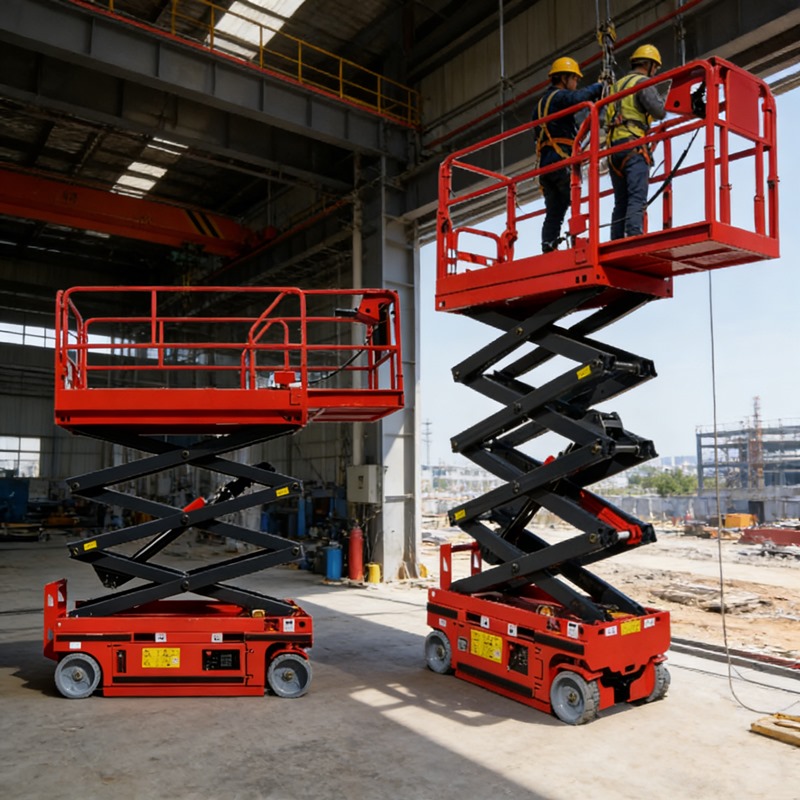
The global industrial scissor lift market is no longer a localized industry; it is a high-tech global supply chain. As of 2026, the landscape is defined by two major shifts: Hyper-Electrification and the Dominance of Advanced Chinese Manufacturing.
Historically, the market was split between expensive "Legacy" brands from the US/Europe and low-cost "Economy" brands. Today, a new "Mid-High" segment has emerged. Manufacturers like TERLION have successfully disrupted the market by offering Tier-1 specifications (Li-ion, CAN-bus, Integrated Hydraulics) at a price point that offers 20-30% better ROI than legacy competitors.
l North America: Driven by the "Infrastructure Bill" and a massive shift toward indoor warehousing, leading to a 9% year-on-year growth in electric scissor lifts.
l Southeast Asia & India: Rapid industrialization is creating a demand for "Tropicalized" equipment—machines designed with enhanced cooling and IP65-rated electronics to survive high humidity and dust.
l Europe: Driven by "Green Building" certifications (LEED/BREEAM), where zero-emission and low-decibel operation (under 70 dB) are mandatory for indoor construction.
Global sourcing carries inherent risks that can jeopardize a project’s timeline or a company’s safety record. To secure a high-value asset, procurement officers must look past the brochure.
A common risk is "Capacity Inflation," where a machine is rated for 500kg but exhibits structural fatigue or hydraulic overheating when operated at that limit for extended shifts.
l Mitigation: Insist on a Dynamic Load Test Report. A professional-grade unit should be tested at 110% to 125% of its rated capacity before leaving the factory.
Some suppliers provide "Self-Declared" CE marks rather than certificates issued by Notified Bodies (e.g., TUV, SGS, Intertek).
l Mitigation: Verify the certificate number on the official portal of the issuing body. Ensure the machine matches the Type Examination Certificate for the specific 2026 standards.
Low-cost machines often use "harness-heavy" electrical systems that are prone to vibration damage.
l Mitigation: Look for Integrated Manifold Blocks in the hydraulics and Automotive-grade Wiring Harnesses in the electrical cabinet. This is a hallmark of the TERLION build quality, reducing wire-chafing failures by nearly 85%.
Procuring an industrial scissor lift is not a one-time transaction; it is a 10-to-15-year strategic decision. The goal is to align the Equipment Class with the Application Intensity.
As we have explored, the true value of a machine lies in its structural rigidity, the intelligence of its power management (Lithium ROI), and its global serviceability. Brands like TERLION represent the future of this industry—combining high-end engineering with the agility of modern manufacturing. When your facility operates on a 24/7 cycle, the machine in your aisle shouldn't just be a tool; it should be a reliable partner in your productivity.
A: DC motors use carbon brushes that wear out and create friction/heat. Brushless AC motors, found in premium TERLION units, are maintenance-free and provide higher torque at low speeds. This is crucial for navigating ramps or precisely positioning a lift in a crowded warehouse. AC motors are also roughly 20% more energy-efficient, extending battery life per charge.
A: LiFePO4 batteries are highly stable but can lose charging efficiency below 0°C. Industrial-grade lifts now come with Internal Battery Heating Systems. These systems use a small portion of the battery's energy to pre-heat the cells to an optimal 15°C before accepting a charge, ensuring the machine remains operational in cold-storage or winter construction environments.
A: Pothole protection reduces the ground clearance of the chassis from roughly 100mm to 20mm once the platform is elevated. This is a mechanical "safety net." If a lift hits an unseen floor crack or hole while elevated, the machine will drop only 20mm before the protection plate hits the ground, preventing a tip-over. Without this, the tilt angle would exceed the stability limit, leading to a catastrophic accident.
A: Generally, no. Indoor-rated lifts are often "Zero-Wind" rated. Outdoor-rated units, like TERLION's Dual-Rated series, are engineered with a heavier base and specialized sensors to handle wind speeds up to 12.5 m/s (approx. 28 mph). Using an indoor lift outdoors is a leading cause of tip-over accidents due to wind-sail effects on the platform.
A: Non-proportional controls are "all or nothing"—the machine moves at one speed. Proportional Control (standard in TERLION models) allows the operator to vary the speed based on how far they move the joystick. This is essential for "inching" near delicate equipment or working in tight spaces where a sudden jerky movement could cause a collision.
A: In a high-quality system using integrated manifolds, maintenance is minimal. You should perform a Hydraulic Oil Analysis every 1,000 hours to check for particulates. Replacing the high-pressure filter and checking for "sweating" at the cylinder seals are the primary tasks. Modern TERLION units use synthetic biodegradable oil options which have a much higher viscosity index and longer life than traditional mineral oils.
A: You must consider the "Point Load" (the weight under a single wheel) rather than just the total machine weight. For a 2,500kg machine, the point load can exceed 800kg depending on the load distribution. Always check your facility's kPa rating against the machine's technical datasheet to prevent floor cracking.


