
Tai'an Hi-tech Development Zone, Shandong, China
Call Us
+86 155-8858-6611


Views: 256 Author: Site Editor Publish Time: 2026-02-19 Origin: Site


Mast lifts are a specialized category of aerial work platforms designed to provide safe vertical access in industrial, construction, and warehouse environments. These machines enable personnel to reach elevated work areas efficiently without relying on scaffolding or cranes, reducing setup time and minimizing operational risks. Their use has expanded significantly over the last decade due to urbanization, the growth of high-density storage facilities, and stricter occupational safety regulations.
Technological developments have further enhanced their operational capabilities. Modern mast lifts incorporate electric and hybrid powertrains, lightweight aluminum alloy structures, and self-propelled mobility. These features allow operation in confined indoor spaces as well as outdoor environments with uneven terrain. Safety systems, including automatic brakes, overload sensors, stabilizing outriggers, and emergency descent mechanisms, are standard, ensuring compliance with ANSI, OSHA, and CE directives.
The combination of efficiency, adaptability, and safety compliance has positioned mast lifts as essential equipment for vertical access operations. They are deployed in applications ranging from industrial maintenance and warehouse operations to mid-rise construction projects. By integrating compact design with regulatory compliance, mast lifts enable operators to maintain productivity while minimizing workplace hazards, making them a critical investment in modern industrial workflows.
Mast lifts can be classified into several categories, each tailored to specific operational requirements. Manual vertical mast lifts are lightweight, hand-operated units primarily used indoors or in confined spaces where portability and low weight are essential. These lifts typically provide working heights between 4 and 8 meters, with platform load capacities of 200–300 kg. Their simplicity reduces maintenance requirements, making them suitable for occasional use.
Self-propelled mast lifts incorporate electric or diesel drives, allowing operators to move the platform without external assistance. These units generally reach working heights of 6 to 20 meters and accommodate payloads from 250 to 500 kg. They are versatile for indoor warehouses, industrial facilities, and outdoor construction sites, often equipped with stabilizing outriggers and non-marking wheels or rough terrain tires depending on the environment.
Telescopic mast lifts offer adjustable platform reach, enabling precise vertical positioning for medium-height applications. Working heights typically range from 8 to 22 meters, with load capacities up to 600 kg. These lifts are often used in industrial maintenance and high-reach construction tasks. Aluminum alloy mast lifts are lightweight and corrosion-resistant, providing enhanced portability and reduced floor load, which is critical for indoor operations. Across all types, compliance with ANSI, OSHA, and CE standards governs platform stability, load distribution, and safety system integration. Understanding these technical distinctions is essential for selecting the appropriate mast lift for a given operational context.
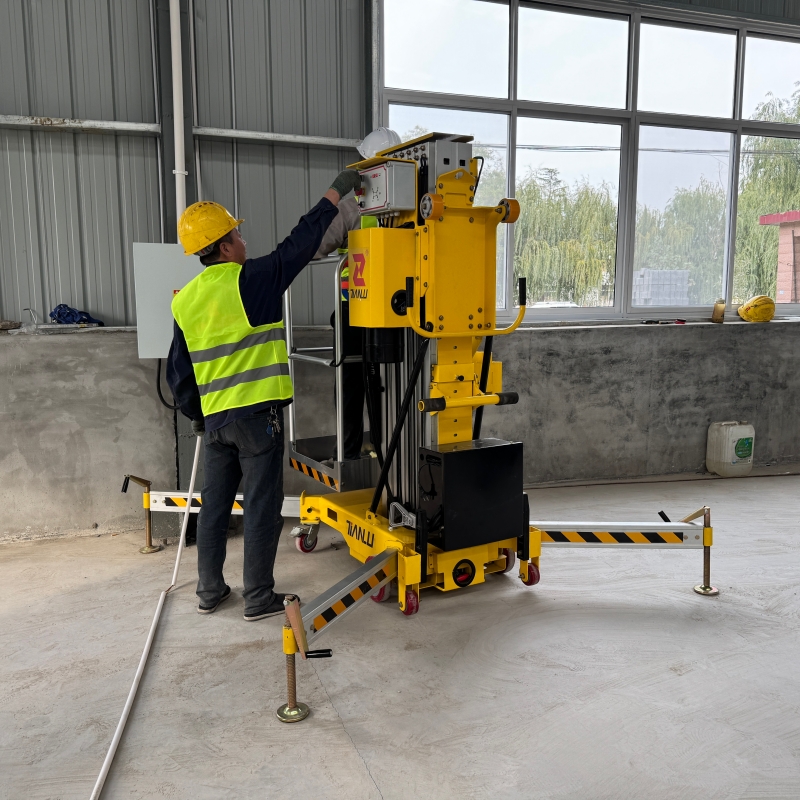
Selecting an appropriate mast lift requires a detailed assessment of operational needs, environmental conditions, and regulatory compliance. Working height is a primary criterion: indoor lifts typically range from 4 to 12 meters, while outdoor or rough terrain lifts can extend up to 25 meters. Load capacity must accommodate both personnel and equipment, usually spanning 200–650 kg depending on the model and intended application.
Terrain compatibility affects mobility and safety. Electric indoor units employ non-marking wheels suitable for smooth surfaces, whereas rough terrain or hybrid lifts utilize heavy-duty tires or tracks to navigate slopes up to 10–15 degrees and uneven ground. Power source considerations are also critical: electric drives minimize emissions and noise for indoor environments, while diesel or hybrid systems provide higher torque and longer operating hours for outdoor or heavy-duty applications.
Compliance with international standards such as ANSI A92.20, OSHA 1910, and CE directives is essential, covering platform stability, emergency controls, and fall protection. Additional considerations include operational frequency, maintenance capacity, and site-specific constraints like floor load limits and overhead clearance. Evaluating these factors ensures that selected mast lifts optimize safety, performance, and regulatory compliance while supporting productivity across various industrial, warehouse, and construction scenarios.
1. JLG Industries operates as a major U.S.–based aerial work platform manufacturer with roots dating back to 1969 and global distribution across North America, Europe, and Asia. Its vertical and mast type lifts include push around and driveable units with working heights ranging from approximately 6 ft to 29 ft (around 2–9 m), and platform load capacities typically from 300 lb to 400 lb (~136–181 kg) depending on configuration. JLG’s electric and hybrid mast lifts are designed for indoor and mixed use facilities, incorporating features such as proportional controls, ergonomic joysticks, and service diagnostics. Its product line also includes telescopic mast variants that are compact enough for weight sensitive floors while maintaining compliance with ANSI/CSA standards, reflecting decades of engineering refinement.
2. Genie (Terex AWP) specializes in vertical mast lifts marketed under the Runabout® and other series, emphasizing lightweight construction and ease of maneuverability. Typical Genie vertical mast lifts reach working heights up to approximately 6 m (20 ft) with platform load capacities in the 159 kg to 227 kg range, and are optimized for warehouse, logistics, and general maintenance applications. These units are designed for tight indoor environments where compact footprint and low floor loading are priorities. Genie also provides a modular accessories ecosystem, including platform extensions and safety packages to match varied use cases.
3. Haulotte Group is a European manufacturer whose mast and telescopic mast lifts generally feature working heights from mid range to higher elevations (often exceeding 20 m) with load capacities up to 600 kg. While specific model data varies across product families, Haulotte units typically integrate advanced stabilization systems, rough terrain mobility options, and compliance with CE and ANSI standards. This supplier’s portfolio includes electric, diesel, and hybrid power configurations suited for outdoor construction sites and industrial facilities with mixed drive conditions. Its focus on modular design allows customization of platform width, mast extension stages, and safety monitoring systems.
4. Skyjack is a Canadian producer with more than 25,000 light mast units manufactured annually and an estimated global market share in the mast lift segment. Skyjack’s product suite includes electric mast lifts with working heights around 6.9 m and payload capacities near 227 kg, as well as multi function models that combine scissor and mast features for flexible task requirements. Noted for simplified maintenance through reduced parts counts, these units are often specified for high frequency use in warehouses and industrial facilities where reliability and lifecycle durability are critical.
5. Snorkel (Xtreme Manufacturing) has a long history in aerial lift production, generating an estimated 20,000+ light mast lifts annually and holding a notable market share. Snorkel vertical and telescopic mast lifts typically offer working heights around 12 m with payload capacities around 272 kg, and articulated configurations extending up to 16 m with capacities near 454 kg. Snorkel models are engineered with energy efficient electric drives, hydraulic systems tuned for smooth elevation, and structural designs compliant with CE and EPA certification requirements, supporting both indoor and outdoor applications.
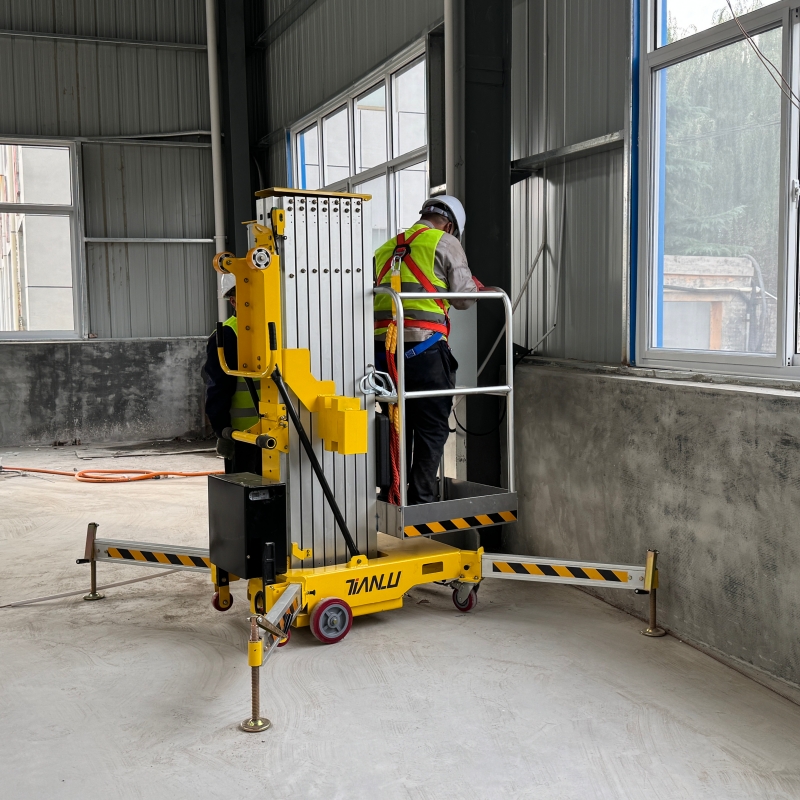
6. Terlion is a Chinese mast lift manufacturer with a broad product range covering manual, self propelled, telescopic, and aluminum alloy mast lifts. Although specific model metrics depend on configuration, Terlion’s electric mast lifts typically span 6–25 m working heights with load capacities up to approximately 650 kg, aligning with international standards such as ANSI, OSHA, and CE. Engineering attention is directed toward operating efficiency, compact design metrics (e.g., turning radius and floor load), and safety system integration (overload protection and automatic braking). Terlion’s market presence is notable in East Asia and emerging markets where price performance trade offs influence procurement decisions.
7. Dingli Machinery (Zhejiang Dingli, China) produces a range of aerial access equipment including electric and hybrid mast lifts with operational heights typically from 4 to over 20 m and load capacities up to 600 kg. Dingli emphasizes modular component architecture, platform stability under dynamic loads, and mobility options suitable for both flat and uneven surfaces. Its portfolio includes units engineered for warehouse logistics, industrial maintenance, and outdoor work sites, with CE and OSHA compliance features such as tilt sensors and outriggers to enhance operator safety. Industry reports consistently list Dingli among notable players in the global aerial platform landscape.
8. Niftylift Ltd. is a UK based manufacturer known for self propelled and vertical mast lifts designed for heights commonly between 6 m and 18 m and payload capacities of 200–500 kg. Niftylift’s product architecture typically integrates articulated and telescopic options tailored to mid range elevation tasks, balanced with compact designs suitable for indoor use. Safety and ergonomic features such as proportional joystick control, precise hydraulic elevation, and robust platform stabilizers support compliance with CE and ANSI standards, making these units viable for facilities with diverse operational requirements.
9. Sinoboom Intelligent Equipment manufactures a diverse range of mast and boom lifts, with vertical models offering working heights from approximately 6 m to 20 m and load capacities between 200 kg and 500 kg. These units integrate electric power systems, advanced control modules, and stabilizing mechanisms suitable for warehouse, industrial, and mid rise construction environments. The company maintains CE compliance and often provides optional configurations for platform enlargement, all terrain mobility, and IoT enabled fleet diagnostics to support preventive maintenance.
10. Aichi Corporation is a Japanese manufacturer included in multiple aerial work platform market analyses for its mast and boom lift products. In vertical lift configurations, Aichi units typically offer range of working heights roughly from 4 m to over 20 m and load capacities up to 600 kg, with both electric and diesel power options. Aichi emphasizes structural durability, operator safety systems, and integration of ergonomic controls tailored to diverse job profiles such as facilities maintenance and industrial access tasks. Its global distribution network serves markets across Asia, Europe, and North America.
When procuring mast lifts, organizations must evaluate both technical specifications and operational support requirements to ensure long-term reliability. Delivery lead times and equipment availability influence project scheduling, while access to spare parts and service networks directly affects operational uptime. Manufacturers with established regional support networks generally provide faster maintenance response and easier access to replacement components.
Maintenance planning is critical for safe operation and regulatory compliance. Hydraulic systems should be inspected every 6–12 months, and electric or diesel powertrains require regular checks every 500 operating hours. Platform components, outriggers, and control systems must be monitored for wear and alignment. Operator training, preventive maintenance schedules, and proper documentation—including maintenance logs, inspection records, and operator manuals—are essential to meet ANSI, OSHA, and CE standards.
Operational context also guides procurement decisions. Indoor environments demand lightweight, compact units with non-marking wheels, while outdoor or rough terrain applications require durable tires or tracks, higher load capacity, and enhanced stabilization. Evaluating these factors allows organizations to select mast lifts that optimize performance, minimize downtime, and ensure safety compliance, thereby achieving cost efficiency and operational reliability over the equipment lifecycle.
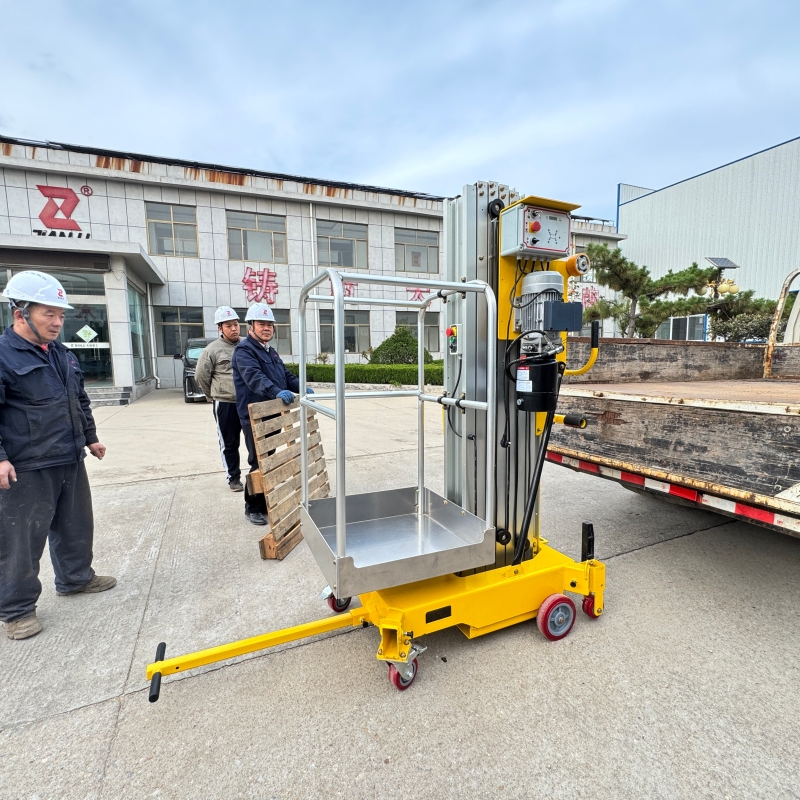
Mast lifts are essential tools for modern industrial, construction, and warehouse operations, providing safe and efficient vertical access where traditional scaffolding or cranes would be impractical. Their versatility, ranging from manual indoor units to self-propelled, telescopic, and rough terrain models, allows organizations to address a wide variety of operational scenarios while maintaining compliance with safety standards.
Effective selection depends on measurable technical criteria, including working height, load capacity, power source, and terrain adaptability. Safety compliance with ANSI, OSHA, and CE standards is critical to ensure operator protection and reduce the risk of workplace incidents. Furthermore, procurement decisions should integrate considerations such as manufacturer support networks, spare parts availability, and preventive maintenance schedules to maximize equipment uptime and operational efficiency.
The global mast lift market offers a diverse array of suppliers, including multinational and regional manufacturers, providing a range of products that cater to different technical requirements and site conditions. By analyzing product specifications, operational environment, and supplier capabilities, organizations can make informed decisions that optimize performance, minimize operational risk, and enhance long-term reliability. Ultimately, mast lifts are a strategic investment in both safety and productivity, supporting efficient vertical access in a wide range of industrial, commercial, and construction applications.


